Functional Programming 3
3.1 Class Hierarchies
Abstract Classes
abstract class 는 다른 언어의 그것과 같다.
abstract class IntSet {
  def contains(x: Int): Boolean
  def incl(x: Int): IntSet
}

object EmptySet extends IntSet {
  def contains(x: Int) = false
  def incl(x: Int) = new NonEmptySet(x, EmptySet, EmptySet)
}

class NonEmptySet(elem: Int, left: IntSet, right: IntSet) extends IntSet {
  def contains(x: Int) = {
    if (x < elem) left contains x
    else if (x > elem) right contains x
    else true
  }

  def incl(x: Int) = {
    if (x < elem) new NonEmptySet(elem, left incl x, right)
    else if (x > elem) new NonEmptySet(elem, left, right incl x)
    else this
  }
}
여기서 재밌는 점은 incl 을 수행할때 새로운 서브트리를 매번 만든다는 것인데, 이건 이 프로그램이 immutable 하다는 것을 말한다.
이전의 데이터들을 변경하지 않으므로 persistent data structures 라 볼 수 있다.
클래스에서는 다른 언어와 마찬지로 override 를 이용해서 existing 혹은 non-abstract definition 을 서브클래스에서 재정의(redefined) 할 수 있다.
Object Definitions
object 키워드를 이용하면 singleton object 를 만든다. 그리고 singleton object 는 value 이기 때문에, 그 자체로 evaluate 된다. 다시말해 evaluation step 이 수행 될 필요가 없다.
object EmptySet extends IntSet {
  def contains(x: Int) = false
  def incl(x: Int) = new NonEmptySet(x, EmptySet, EmptySet)
}
Exercisee
Write a method
unionfor forming the union of two sets. You should implement the following abstract class
  def union(other: IntSet): IntSet = {
    ((left union right) union other) incl elem
  }
해석하면 terminal node 의 경우, union 연산이 other incl elem 이 된다. 게다가 매번의 left union right 연산은 현재보다 더 작은 단위를 호출하고, (left union right) union other 은 적어도 좌측 operand 가 적어 현재보다 1개 작은 elem 을 가지고 있기 때문에 최소한 자기 자신을 다시 호출하지 않는다는 것을 알 수 있다. 따라서 이런 점을 고려하면 함수는 언젠가 끝난다는 것을 알 수 있다.
Dynamic Binding
Object-oriented language implement dynamic method dispatch. This means that the code invoked by a method call depends on the runtime type of the object that contains the method
이렇게 보면, Dynamic dispatch 는 ** higher-orher functions** 와 유사한데, 둘 다 static 타임에 어떤 함수가 실행될 지 알 수 없다. 그럼 둘을 섞으면 어떻게 될까?
3.2 How Classes Are Organized
스칼라에서 class 들은 package 로 관리된다. 스칼라에서 자동으로 임포트하는 것들은
- All members of package
scalalike scala.Int - All members of package
java.langlike java.lang.Object - All members of the singleton object
scala.Predeflike scala.Predef.require
Trait
A trait is declared like an abstract class, just with trait instead of abstract class
trait Planar {
  def height: Int
  def width: Int
  def surface = height * width
}
Trait 는 자바의 Interface 와 비슷하지만, fields 와 concrete methods 를 포함할 수 있다는 점에서 더 강력하다. 반면 Trait 는 parameter 를 가질 수 없다.
Scala’s Hierarchy

(http://librairie.immateriel.fr/fr/read_book/9780596155957/ch07s04#scalas-type-hierarchy)
그림을 보면 알겠지만, 가장 상위에 scala.Any 가 있고, 그 아래로 기본 타입들은 scala.AnyVal 아래에 위치한다. 스칼라의 Double 은 자바의 double 와 일치한다. java.lang.Double 과는 다르다. java.lang.Double 은 아래 설명을 보면 알겠지만, AnyRef 하위에 위치한다.
레퍼런스 타입은 scala.AnyRef 아래에 위치 한다. 그리고 scala.AnyRef 는 자바의 java.lang.Object 와 동일하다. 모든 스칼라 오브젝트들은 scala.AnyRef 를 하위에 위치한다. 받는다.
정리하자면 primitive type 은 scala.AnyVal 하위에 있고, object 는 scala.AnyRef 하위에 있다고 보면 된다.
그리고 하위에 보면 scala.Nothing 과 scala.Null 이 Trait 로 존재하는 걸 확인할 수 있다.
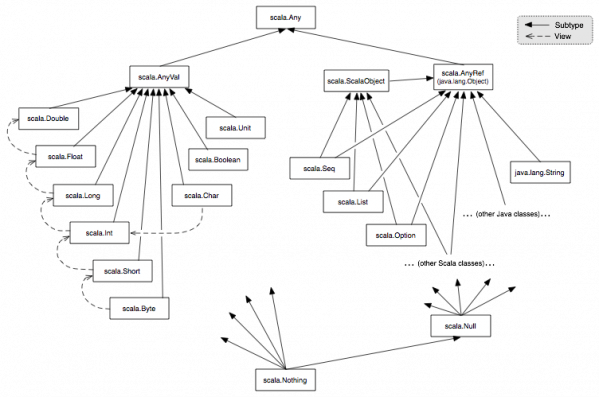
http://docs.scala-lang.org/tutorials/tour/unified-types.html
그림이 좀 작긴 한데, 자세히 보면 dotted arrow 가 있는걸 볼 수 있다. 이건 해당 타입이 화살표가 이어진 곳에 있는 타입으로 자동으로 converted 될 수 있는지의 여부다. 따라서 아래와 같은 REPL 실행 결과를 얻을 수 있다.
scala> val a: Byte = 1
a: Byte = 1

scala> val b: Short = a
b: Short = 1

scala> b
res0: Short = 1

scala> val c: Byte = b
<console>:9: error: type mismatch;
 found   : Short
 required: Byte
       val c: Byte = b
                     ^
Top Types
Any 은 모든 타입의 베이스 타입으로, ==, !=, equals, hashCode, toString 등의 메소드를 포함하고 있다.
The Nothing Type
http://docs.scala-lang.org/tutorials/tour/unified-types.html
Nothing 은 Scala’s type hierarchy 가장 아래쪽에 위치하는데, 모든 타입의 subtype 이다. Nothing 은 또한 값이 없는데, 다음의 두 가지 경우 유용하다.
(1). To signal abnormal termination
(2). As an element type of empty collections. ex) Set[Nothing]
참고로, Exception 의 타입도 Nothing 이다.
Null
Null 은 모든 scala.AnyRef 하위에 있는 타입의 서브타입이다.
Every reference class type also has null as a value.
null 의 type 이 바로 Null 이다. Null 은 java.lang.Object, 즉 scala.AnyRef 를 상속받는 모든 클래스의 서브타입이기 때문에 scala.AnyVal 과는 incompatible 하다.
scala> null
res1: Null = null

scala> val a:String = null
a: String = null

scala> val b: Int =  null
<console>:7: error: an expression of type Null is ineligible for implicit conversion
       val b: Int =  null
참고로 if (true) 1 else false 의 타입은 AnyVal 인데 1과 false 의 공통적인 상위 타입은 AnyVal 이기 때문이다.
3.3 Polymorphism
대부분의 함수형 언어에서 기본적인 데이터 구조는 immutable linked list 다. 이건 Nil 과 Cons 로 구성되어 있는데, Nil 은 empty list 를, Cons 는 element 를 담고있는 부분을 말한다. 리습의 그것과 같다.

http://en.wikipedia.org/wiki/Cons
이번시간엔, Cons 와 Nil 들을 구현해 보자.
trait List[T] {
  def isEmpty: Boolean
  def head: T
  def tail: List[T]
}

class Cons[T](val head: T, val tail: List[T]) extends List[T] {
  def isEmpty = false
}

class Nil[T] extends List[T] {
  def isEmpty = true
  def head = throw new NoSuchElementException("Nil.head")
  def tail = throw new NoSuchElementException("Nil.tail")
}
여기서 클래스에 있는 파라미터, val head: T 를 Value Parameter 라 부른다. val 의 경우에는 자동으로 public getter 를 만들어 준다.
그리고 [T] 에서 T 는 Type Parameter 다. 타입 파라미터는 클래스 뿐만 아니라 함수에도 적용할 수 있는데,
def signleton[T](elem:T) = new Cons[T](elem, new Nil[T])
는 정상적으로 컴파일 된다. 물론 스칼라는 강력한 Type Inference 를 지원하기 때문에
singleton[Boolean](true) 대신 스칼라 컴파일러는 type inference 를 이용해서 singleton(true) 혹은 singleton(1) 를 받아들인다.
Types and Evaluation
Type parameters do not affect evaluation in Scala
재밌게도 Scala 프로그램이 evaluation 될 때 [T] 와 같은 Type parameters 는 전혀 영향을 미치지 않는다. 왜냐하면 Scala 가 evaluation 전에 모든 Type parameters 와 Type arguments 를 제거하기 때문이다.
이 과정은 Type erasure 로 불린다. Java, Scala, Haskell, ML, OCaml 등은 Type erasure 를 이용하고, 런타임에도 Type parameters 를 유지하는 언어는 C++, C#, F# 등이 있다.
Polymorphism
Polymorphism 은 “in many forms” 라는 뜻이다. 프로그래밍에서는 다음과 같은 의미를 가진다.
(1) the function can be applied to arguments of many types or
(2) the type can have instances of many types
이 정의로부터 두 가지 사실을 끌어낼 수 있는데,
(1) subtyping: instances of a subclass can be passed to a base class
(2) generics: instances of a function or class are created by type parameterization
사실 subtyping 은 OOP 언어에서 먼저 온 것이고, generics 는 함수형 언어에서 온 것이나, Scala 는 모두 사용한다.
중요한 내용이므로 다시 한 번 정리 하면 다형성 이란, 다양한 형태를 가지고 있다는 뜻인데, 프로그래밍에서는 다음과 같은 의미를 지닌다.
(1) 함수는 다양한 타입의 인자를 받아들일 수 있다.
(2) 타입은 다양한 타입의 인스턴스를 가질 수 있다.
따라서 함수나 클래스의 인스턴스는 type parameterization 을 통해 생성될 수 있으며, 하위 클래스의 인스턴스는 상위 클래스로서 동작할 수 있다.
Exercise
Write a function
nththat takes an intergernandalist and selects the n’th element of the list
If index is outside the range from 0 up the length of the list minus one, aIndexOutOfBoundsExceptionshould be thrown
def nth[T](n: Int, list: List[T]): T = {
  if (list.isEmpty) throw new IndexOutOfBoundsException("out of bound index")
  else if (n == 0) list.head
  else nth(n - 1, list.tail)
}
comments powered by Disqus